To read a Destiny Matrix chart, begin with the center number. Then read the four main points, ancestral square, karmic tail, love line, money line, talents, purpose, and current age-ring segment. Do not read a number on its own. Combine its Arcana meaning with its position, then look for repeats and contrasts across the chart.
This guide starts with a precalculated chart and focuses on interpretation. For the system's definition, history, 1-22 Arcana reference, formulas, and reasons calculators may disagree, read What Is a Destiny Matrix Chart?.
If you do not have a chart yet, use the free calculator below. Keep the result open as you follow this guide.
Key takeaways
- Read from the center outward. The center is the main lens, not the whole reading.
- Use the four main points to understand the chart's basic structure.
- Read every number as Arcana meaning + chart position.
- Within this reading method, repeated numbers are treated as recurring themes. They are not automatically good or bad.
- Compare connected positions before writing a conclusion.
- Use the chart for reflection. Do not use it as the sole basis for major life, relationship, health, or financial decisions.
A practical order for reading a Destiny Matrix chart
For a first reading, use this order:
- Center number
- Four main points
- Ancestral square
- Repeated numbers
- Karmic tail
- Love and money lines
- Talents, purpose, and current age-ring segment
Some readers begin with the four main points because those numbers are calculated first. Others begin with the center because it gives the quickest overview of the chart. Both approaches can work. This guide begins with the center, then checks it against the four main points. That order is easier for a beginner and still preserves the logic of the calculation.
Here is the short version:
| Read this | What it helps you ask |
|---|---|
| Center | What theme holds the chart together? |
| Left, top, right, and bottom points | How do personality, gifts, material lessons, and core challenges differ? |
| Ancestral square | Which family or inherited themes frame the personal chart? |
| Repeated numbers | Which themes appear in more than one area? |
| Karmic tail | Which reaction or lesson may repeat? |
| Love line | How do closeness, choice, trust, and repair work? |
| Money line | How do value, work habits, structure, and resources interact? |
| Talents and purpose | Which strengths need direction and practice? |
| Current age-ring segment | Which 15-month symbolic theme is active on the age ring? |
The worked chart used in this guide
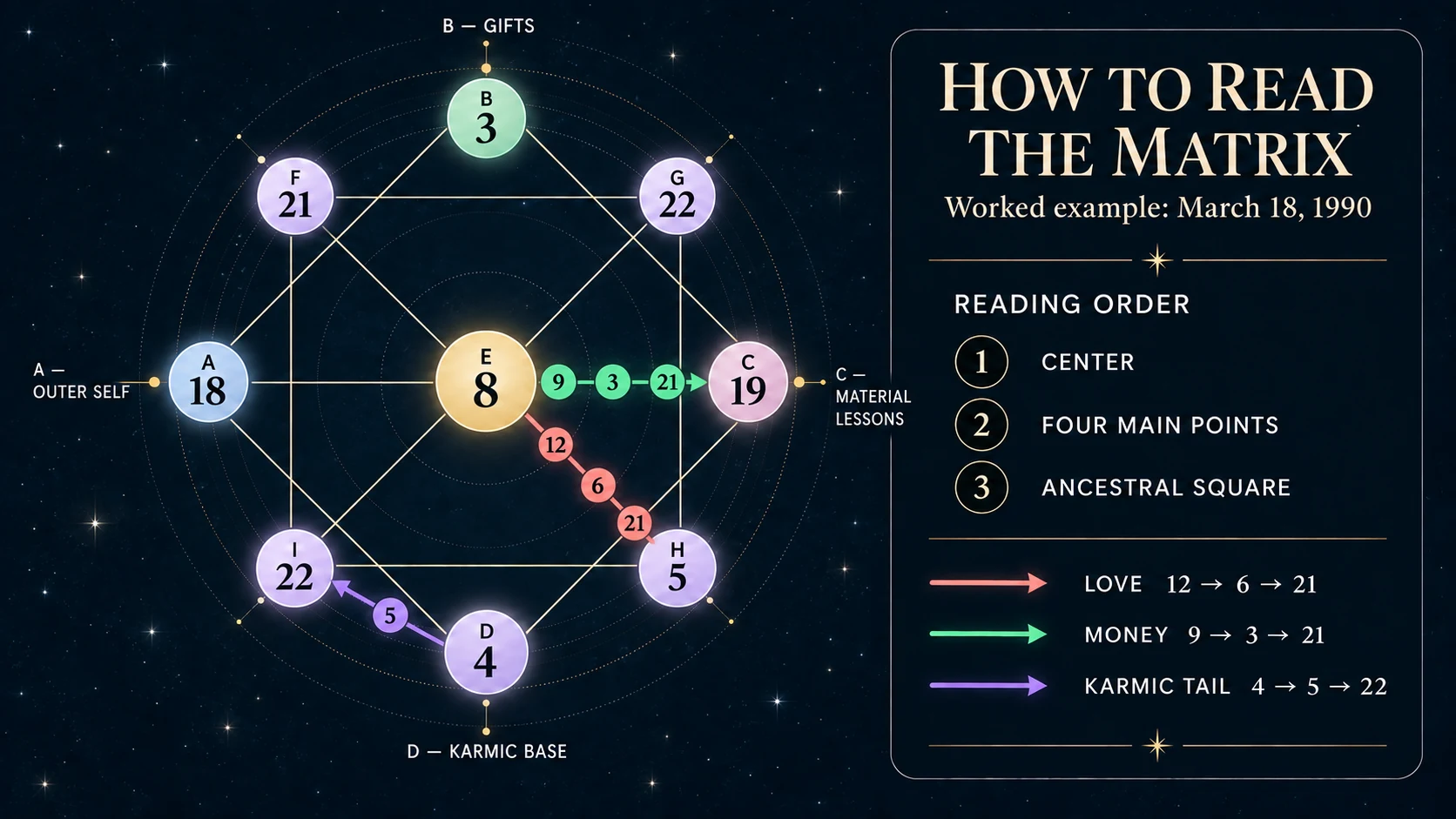
We will interpret the chart for 1990-03-18. The values are already calculated
so we can concentrate on what each position contributes and how the positions
work together.
| Chart area | Values used in the walkthrough |
|---|---|
| Center | E = 8 |
| Four main points | A = 18, B = 3, C = 19, D = 4 |
| Ancestral corners | F = 21, G = 22, H = 5, I = 22 |
| Karmic tail | 12-16-4 |
| Love line | 12-6-21 |
| Money line | 9-3-21 |
| Talents | 3-14-11 |
| Purpose | Personal 17, social 16, spiritual 6 |
| Current age-ring segment | Jun 18, 2026-Sep 18, 2027: 11 |
Use the annotated chart above to locate each value. If you want to reproduce the arithmetic first, follow the calculation formulas and worked example before continuing. Keep one calculator and one calculation method throughout a reading so the positions do not change halfway through.
Interpretation convention: This guide uses the position meanings adopted by DestinyMatrix.one. Other Destiny Matrix schools and calculators may label or interpret the same positions differently.
Numbering convention: DestinyMatrix.one uses 8 for Justice, 11 for Strength, and 22 for The Fool. Other Tarot traditions may number these archetypes differently. The Victoria and Albert Museum's Tarot history shows how Tarot developed from historical card games into decks with varied imagery and later uses.
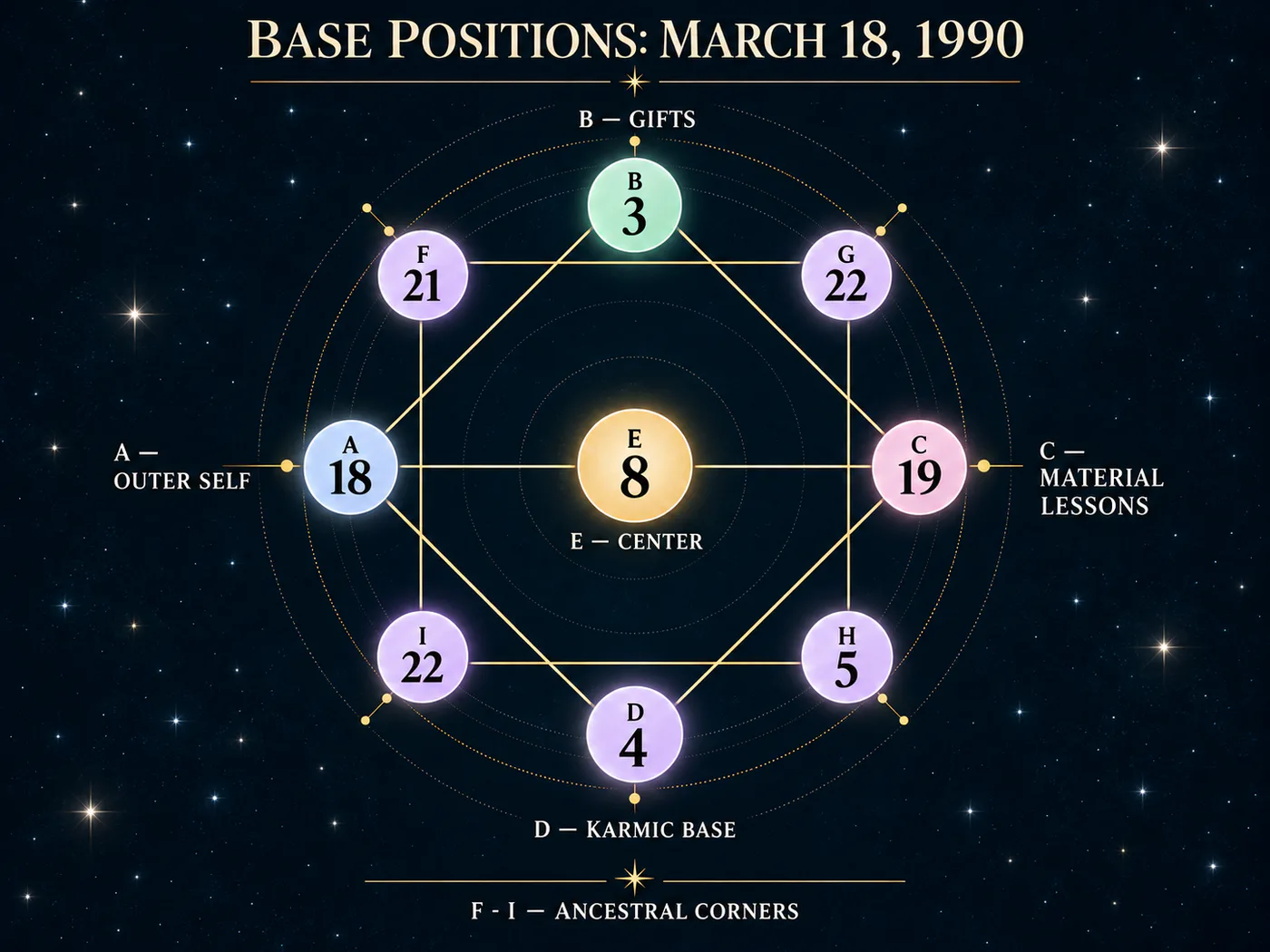
The letters identify chart positions; the number inside each node supplies the Arcana theme interpreted in that position.
Step 1: Read the center number
In this guide, the center represents the chart's central theme and the patterns that may feel most familiar. It does not describe your entire personality.
If you need to calculate or verify the center and other 1–22 values first, use the free Arcana Number Calculator. It shows the chart position, card name, and calculation steps for each result.
Read the center in three passes:
- Name the Arcana theme.
- Describe a balanced expression.
- Describe what happens when the same theme becomes rigid or automatic.
In our example, the center is 8, Justice. Its main themes are balance, truth, fairness, and accountability.
A balanced expression may include clear judgment, respect for agreements, and a wish to make fair decisions. Under pressure, the same theme may become harsh self-judgment, rigid standards, or constant scorekeeping.
Do not stop at "you are fair." Ask for behavior:
- Do I make decisions more easily when the rules are clear?
- Do I expect more consistency from myself than from other people?
- When something feels unfair, do I discuss it or keep a private score?
These questions turn a broad symbol into something you can test in daily life.
Step 2: Read the four main points
The four main points form the personal square. Each point gives a different context to its number.
Left point: outer self and first impression
The left point comes from the day of birth. It is often read as the visible self, personal style, or the energy other people notice first.
Here, the left point is 18, The Moon. The Moon is linked with emotion, imagination, uncertainty, and sensitivity to what is not being said. In this position, it may suggest a person who notices mood and subtext quickly. A less balanced expression may involve uncertainty, projection, or waiting too long for complete emotional clarity. It does not mean the person is deceptive.
Now compare it with center 8. Justice wants clarity. The Moon notices ambiguity. That contrast may create a useful strength: careful judgment. It can also create tension when the person demands certainty from a situation that is still unclear.
Top point: gifts, social energy, and higher direction
The top point comes from the birth month. In this framework, it represents gifts, values, and social or spiritual direction. It asks what draws you beyond everyday concerns.
At the top of this chart is 3, The Empress. Its themes include creativity, care, growth, and the ability to develop an idea over time. In the top position, it may point to a gift for helping people or projects grow and creating supportive environments.
The practical question is not "Am I creative?" Ask: what do I consistently help grow, and what conditions help that work continue?
Right point: material lessons
The right point comes from the reduced year. It covers practical life, your role in the wider world, resources, and material concerns.
The right point is 19, The Sun. Its themes include visibility, warmth, confidence, and vitality. In this position, it can raise questions about being seen, taking credit, sharing success, and staying open without depending on approval.
Bottom point: main challenge and karmic base
The bottom point is calculated from the other three main points. It forms the base of the chart and the karmic tail.
The bottom point is 4, The Emperor. Its themes include structure, boundaries, authority, and responsibility. In this position, the growth task may involve building reliable structure without turning structure into control.
Treat this as a working question, not a sentence about fate:
Where would a clear boundary help, and where am I using rules to avoid uncertainty?
Step 3: Read the ancestral square
The four diagonal corners form the ancestral square. In this framework, they represent family patterns, parental influences, and strengths learned within the family.
Use careful language here. A number cannot prove that a specific event happened to an ancestor. Read these points as prompts for patterns you can observe in family stories, roles, expectations, and learned behavior.
Our example has 21, 22, 5, and 22:
- 21, The World: completion, integration, and seeing the bigger picture.
- 22, The Fool: freedom, trust, experimentation, and new starts.
- 5, The Hierophant: teaching, shared values, tradition, and guidance.
- 22 repeated: within this method, freedom and new beginnings receive extra attention.
This combination could raise a useful family question: how does this family balance tradition with freedom? It would be too strong to claim that the chart proves rebellion, migration, or a specific family event.
Step 4: Look for repeated numbers and contrasts
Repeated numbers help connect meanings across the chart. In this method, each occurrence brings the same symbolic theme into a different position.
In our example, 22 appears twice in the ancestral square. That does not make 22 twice as lucky. For this reading, we give its themes extra attention across the related ancestral positions.
Use this method:
- Find every repeated number.
- Write down each position where it appears.
- Name the shared Arcana theme.
- Ask how that theme changes across those positions.
Also look for contrasts. Center 8 seeks balance and clear accountability. Left point 18 moves through feeling and uncertainty. Bottom point 4 seeks order. The chart may therefore carry a recurring tension between intuition, fairness, and control.
A contradiction may reflect a real behavioral tension, a broad archetype, or simply a poor fit. Compare both sides with specific behavior. A person can want clear rules and still make many decisions through feeling. If neither side matches your experience, discard that part of the reading.
Step 5: Read the karmic tail without fear
Karmic-tail readings are easy to overstate.
DestinyMatrix.one calculates the karmic tail along the bottom ray. Read it from the inner point nearest the center, through the middle point, to the large bottom anchor. In our example, the code is 12-16-4:
- 12, The Hanged Man: pausing, releasing force, and seeing another angle.
- 16, The Tower: facing a weak structure and rebuilding it honestly.
- 4, The Emperor: structure, responsibility, and boundaries.
Read the sequence as a pattern to explore. One possible synthesis is learning to pause, rebuild honestly, and create structure without rigid control. That is not proof of a past life, punishment, or future event.
Use the free Karmic Tail Calculator to find your three-number sequence and check every calculation step before interpreting it.
For a different combination, read our 12-19-7 Warrior guide. It explains the symbolic themes, everyday examples, and what to do if the description does not fit.
Our 6-8-20 Karmic Tail guide uses family expectations as a reflection topic. It separates the traditional “Disappointment of the Clan” label from your actual family experience and distinguishes forgiveness, contact, trust, and practical help. Use the examples to examine your own choices, rather than treating the code as evidence about your relatives.
If a traditional name makes you worry about your relationships, read our 9-12-3 Karmic Tail meaning and the “Lonely Woman” label. It explains why the label cannot predict whether you will stay single, with examples of solitude, giving, and receiving support.
Ask:
- Which rules help me, and when do I defend a structure that no longer works?
- When does responsibility become control?
- What changes when I pause instead of forcing an immediate repair?
- What would a more flexible structure look like?
A useful karmic-tail reading should make the pattern easier to examine. It should not create fear.
The Karmic Tail uses the inner-to-bottom order described above. For the love and money lines below, read from the outer point toward the center. In every case, the sequence matters more than any isolated number.
Step 6: Read the love line
The love line is used to explore closeness, emotional pacing, choice, trust, boundaries, and repair. It does not identify a guaranteed soulmate or predict marriage.
To find and read your three Love Line numbers, use the dedicated calculator and guide. It shows the three positions and how to read them in order.
This chart's love line is 12-6-21:
- 12, The Hanged Man: pause, a new point of view, and letting go of forced progress.
- 6, The Lovers: choice, connection, and alignment between values and action.
- 21, The World: integration, completion, and a wider sense of partnership.
Read the line as a sequence. Here, connection may improve when the person pauses and considers another viewpoint. The next step is a clear choice, followed by a relationship that respects both partners' independence.
This reading avoids claims such as "12 means delay" or "6 means you will meet a soulmate." It follows the sequence without turning it into a prediction.
If you want to compare two people, do not infer compatibility from one chart. First, learn how to read a compatibility chart. When you are ready, compare two birth dates in the compatibility calculator.
Step 7: Read the money line
The money line is a symbolic view of work habits, value, confidence, effort, and resources. It is not a forecast of salary, wealth, or investment returns.
This chart's money line is 9-3-21:
- 9, The Hermit: depth, independent thought, and patient study.
- 3, The Empress: creation, care, growth, and development.
- 21, The World: integration, completion, and bringing finished work to a wider audience.
One possible reading is that careful study creates value when you turn it into useful work and finish it. Questions to consider include:
- Do I spend too long preparing before sharing my work?
- What knowledge could become a finished service, product, or body of work?
- Which projects need care, and which simply need completion?
Do not use the line to choose an investment or make a major financial decision. Use it to examine work habits and value creation.
Read talents and purpose
In this framework, talent positions describe abilities that may come naturally but still need practice. Purpose numbers place those abilities in a wider personal, social, or spiritual context. Neither section assigns one mandatory career.
The talent line in this chart is 3-14-11:
- 3, The Empress: growth and creative development.
- 14, Temperance: moderation, integration, and the ability to combine different elements.
- 11, Strength: courage, compassion, and self-mastery.
Together, these talents may support teaching, mentoring, or developing ideas with patience. Look for evidence: where has the person already shown this combination in study, work, relationships, or creative projects?
The same chart has these purpose numbers:
| Purpose | Number | Reflection theme |
|---|---|---|
| Personal | 17, The Star | Hope, renewal, and a direction worth developing |
| Social | 16, The Tower | Questioning weak structures and rebuilding with more honesty |
| Spiritual | 6, The Lovers | Making choices that match stated values |
Read these as broad directions, then test them against real choices. For this example, the three numbers may point to a path from inspiration, through honest change, toward clearer alignment. They do not assign one career or mission. Avoid claims such as "you were born to become a teacher" unless the person's skills, interests, and choices support it.
Read the current age-ring segment
DestinyMatrix.one displays 64 consecutive periods around the age ring. Each period lasts 15 months. The first begins on the birth date, and the sequence ends at age 80. It does not restart after that point. The active period is selected with calendar months, not a rough day-count estimate.
For this worked example, the active period on September 22, 2026 runs from June 18, 2026 to September 18, 2027. Its Arcana is 11, Strength. Read that as a temporary reflection theme around steady courage and restraint, not as a forecast. Paired with center 8, Justice, a useful question is: how can I state a fair boundary without becoming harsh or controlling?
The birth chart and all 64 activation points stay fixed. Only the highlighted period changes as the person moves along the age ring between ages 0 and 80. If another website gives you a different timing number, check its period length, boundary dates, and formula before comparing meanings.
For other meanings, use the 1-22 Arcana reference. Then return here to interpret the number by its position and connections.
How to combine the chart into one reading
The main challenge is deciding which themes matter most and how they fit together.
Use this five-part method:
1. Write one sentence about the center
Keep it balanced. Include both the strength and the pressure.
Center 8 values fairness and clear standards, but may become rigid when the situation feels uncertain.
2. Compare the center with the four main points
Look for support and tension. In the example, center 8 and bottom 4 both value order. Left point 18 adds emotion and ambiguity.
3. Mark repeated themes
Do not only count repeated numbers. Related themes can repeat through different Arcana. Justice, the Emperor, and the Hierophant all raise questions about rules, responsibility, and values, even though their numbers differ.
4. Read the lines as sequences
Avoid three separate definitions. Ask how one position leads into the next. For the example love line, pause and perspective lead to clearer choice, which supports a more integrated partnership.
5. End with a useful question
A reading should lead to observation or action. It should not end with a label.
For this chart, a concise synthesis could be:
This chart centers on fairness, structure, and responsibility. It also points to emotional sensitivity and a repeated desire for freedom. The main question is how to create clear structure without dismissing uncertainty or limiting exploration. At work, careful study creates value when it leads to useful, finished work. In relationships, pausing before making a clear choice may make repair easier.
This synthesis does not claim to know the person's future.
Test the reading against real behavior
The accuracy and evidence section explains why broad personality statements can feel unusually personal. During an actual reading, use these four checks before accepting an interpretation:
- Make it specific. What observable behavior does the statement describe?
- Look for a counterexample. When has the opposite also been true?
- Compare contexts. Does the pattern appear at work, in relationships, or only in one situation?
- Leave room for choice. Does the interpretation offer a question or option, or does it make a fixed claim?
"You care about fairness" is broad. "You delay decisions when the rules are unclear, then become strict once you choose" is specific enough to examine.
Common mistakes to avoid
Reading one number as your identity
The center is important, but it is only one position. Always compare it with the main points and lines.
Ignoring position
Number meaning gives you the symbol. Position gives you the question. Arcana 4 in the center is not read in the same way as Arcana 4 in the karmic tail.
Reading only positive meanings
Every theme can be flexible or rigid. Include both expressions without calling the person good, bad, evolved, or unevolved.
Treating a difficult Arcana as a warning
Death, the Devil, the Tower, and the Moon are symbols. Do not turn them into literal predictions of death, disaster, betrayal, or illness.
Mixing calculation systems
Check the reduction rule, Arcana numbering, and line order before comparing two charts or tutorials.
Making decisions from the chart alone
Do not use a symbolic reading as a substitute for medical, legal, financial, psychological, or relationship advice.
First-reading worksheet
Use this short worksheet with your chart:
- My center number is _, and its main theme is _.
- My four main points are _, _, _, and _.
- The strongest support for my center is ___.
- The clearest tension with my center is ___.
- The numbers or themes that repeat are ___.
- My love line suggests I should examine ___.
- My money line suggests I should examine ___.
- One talent I already use is ___.
- One statement I need to test against real behavior is ___.
- One practical question I will take with me is ___.
If you cannot fill every line, stop. A focused first reading is more useful than twenty disconnected definitions.
Protect your birth-date information
A Destiny Matrix calculator needs a birth date. A birth date can be identifying information, especially when it is combined with other personal data. NIST includes date and place of birth among information that can help identify a person when linked with other data. See the NIST definition of personally identifiable information.
Before using any calculator, check how the site uses and stores the information. Do not submit another person's birth date without their permission or another reasonable basis. You can review the current DestinyMatrix privacy policy before generating a chart.
FAQ
How do I read my Destiny Matrix chart?
Start with the center number. Then read the four main points, ancestral square, repeated numbers, karmic tail, love line, money line, talents, purpose, and current age-ring segment. Combine the number meaning with its position.
Should I interpret each number separately?
No. Begin with the number's Arcana theme, add the meaning of its position, then compare it with connected and repeated numbers. A list of isolated definitions is not a complete chart reading.
What does it mean when a number repeats?
In this reading method, a repeated number is treated as the same symbolic theme appearing in several positions. Read each position separately, then ask what the shared theme adds to the whole chart. Repetition is emphasis within the method, not a guarantee of a positive or negative outcome.
Is the karmic tail bad?
No. Read it as a symbolic prompt about a recurring lesson or reaction. It is not proof of punishment, a past life, or an event that must happen.
Can a Destiny Matrix chart predict relationships or money?
No. The love and money lines can support reflection on habits, values, choices, and patterns. They cannot guarantee a partner, career, income, or outcome.
Can I read compatibility from one Destiny Matrix chart?
No. One personal chart can show relationship themes, but it cannot compare two people. Start with the compatibility chart reading guide, then use the compatibility calculator with both birth dates.
What if an interpretation does not fit?
Check that you are reading the correct position, rewrite the claim as observable behavior, and look for a counterexample. If it still does not fit, discard it. You do not need to force a symbol to match your life.