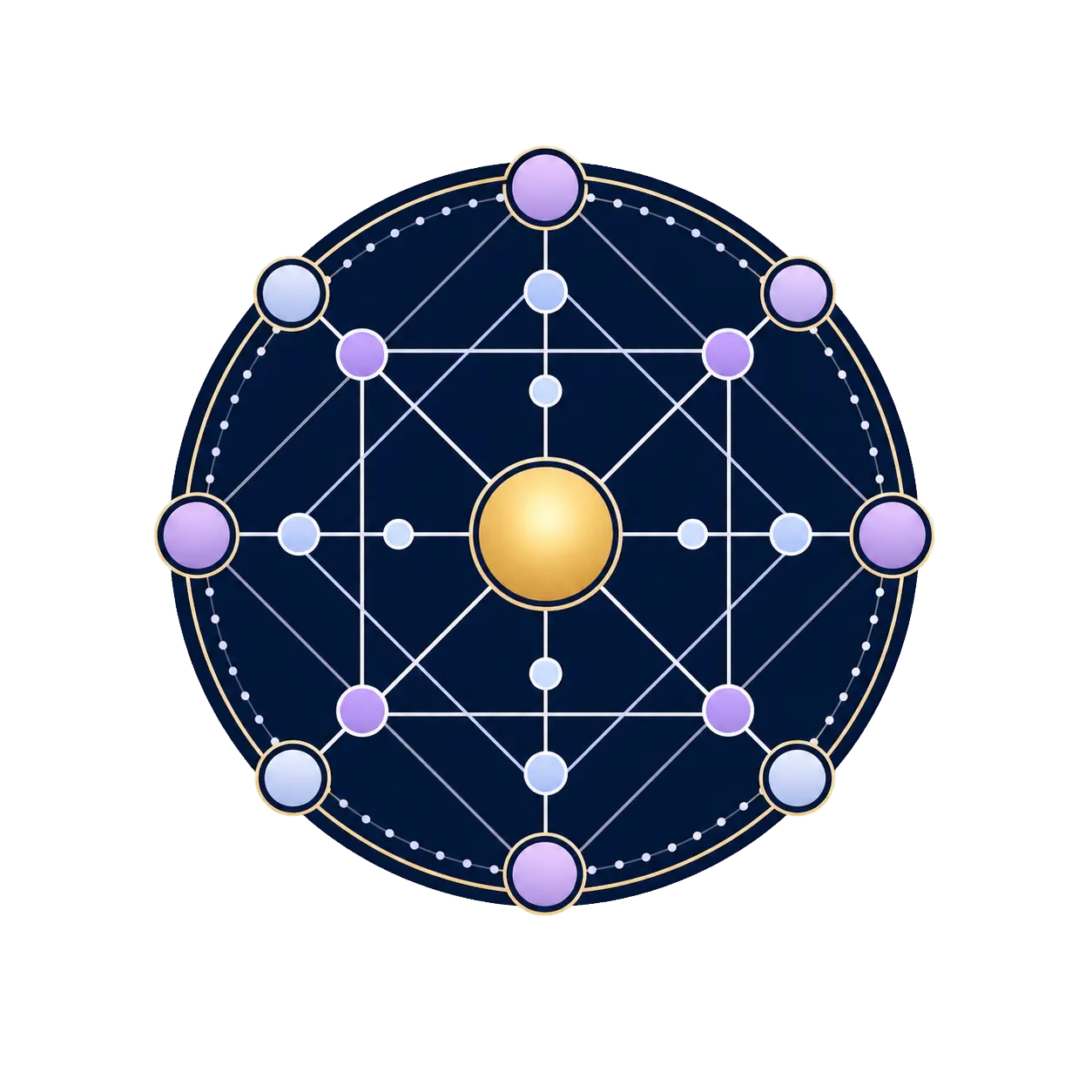
To read a Destiny Matrix compatibility chart, read both individual charts first. Then move through the combined center, meeting point, shared Arcana, love line, practical compatibility, and sensitive pattern. Read the compatibility score last. It is a summary of selected chart similarities, not the chance that a relationship will succeed.
Before you interpret the chart: The Destiny Matrix is a modern symbolic self-reflection system. Natalia Ladini's own website identifies her as the method's author and connects the system with 22 energies. That is the creator's account of the method, not independent scientific validation. Use the chart to describe patterns and start conversations, not to predict marriage, breakup, or whether someone is safe to be with.
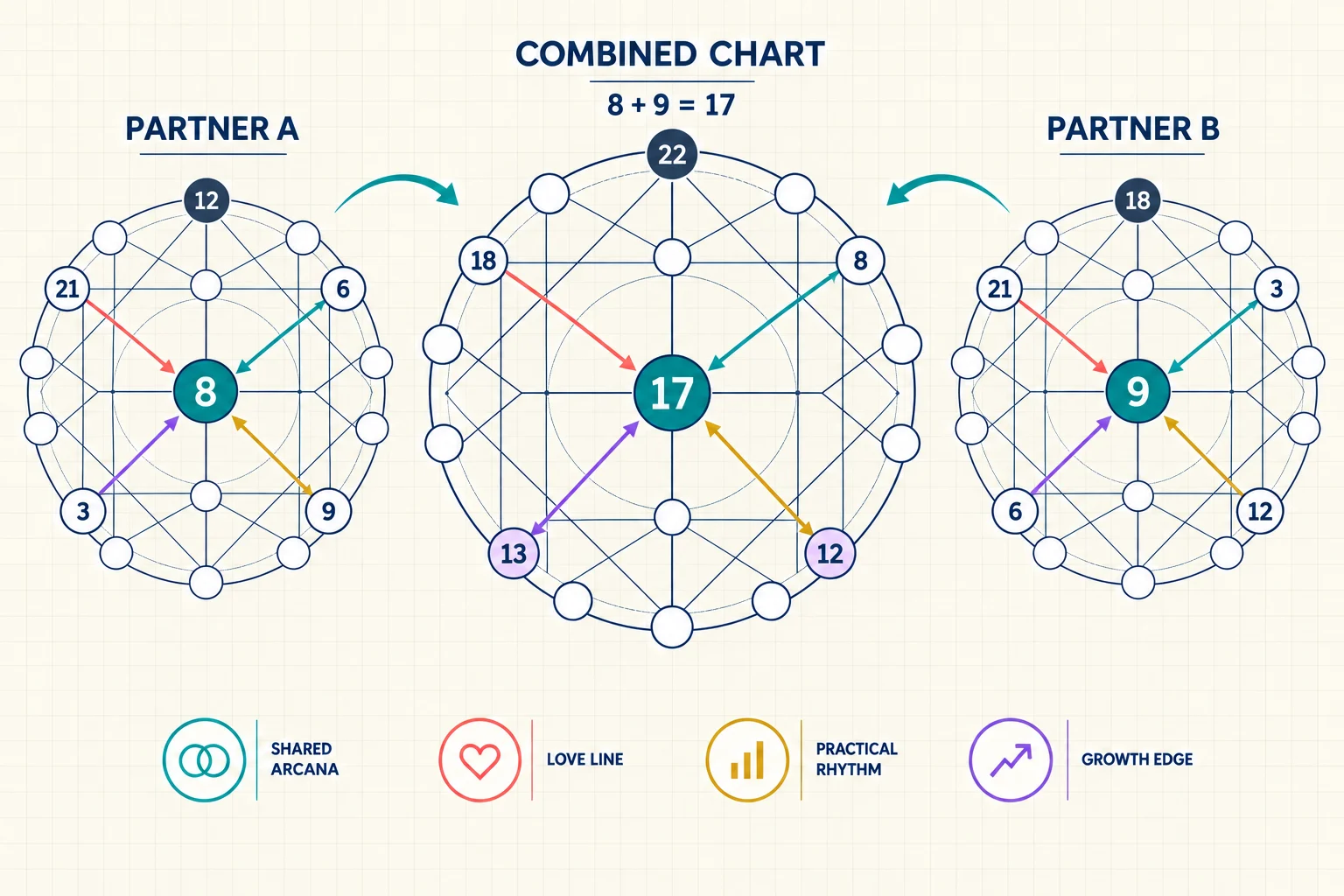
Key takeaways
- Read both individual charts before interpreting the relationship chart.
- Start the joint reading with the combined center, not the score.
- Read every number through its position. The same Arcana can mean something different on the love line and the money line.
- Shared numbers can create familiarity, but they can also repeat the same blind spot.
- Our 0-100 score is a site-specific reflection aid. It is not part of the original method and is not a scientific probability.
- Check every interpretation against real behavior, clear agreements, and both people's experience.
What is a Destiny Matrix compatibility chart?
A Destiny Matrix compatibility chart is a symbolic comparison built from two birth dates. Each birth date creates an individual chart with values from 1 to 22. Selected positions from the two charts are then compared or combined to describe the pattern the two people may create together.
The system's 22 energies draw on the language of the Tarot Major Arcana. According to the Victoria and Albert Museum's history of Tarot, a standard 78-card Tarot deck contains 22 Major Arcana and 56 Minor Arcana. Tarot began as a card game. Its use for divination developed much later. Natalia Ladini's own website presents her as the author of a method that links a birth date with 22 symbolic energies. This identifies Ladini as the method's creator, but it does not validate the method's claims.
That history matters. The chart can offer a shared language for reflection, but its symbols are not measured relationship traits. A number should lead to a question, not a verdict.
If the individual chart still feels unfamiliar, first read What Is a Destiny Matrix Chart? and How to Read a Destiny Matrix Chart.
Compatibility chart vs. two-chart comparison
These terms are often mixed together, but they describe two useful views:
| View | What it shows | Best question |
|---|---|---|
| Two individual charts | Each person's center, love line, money line, purpose, and repeating patterns | What does each person bring into the relationship? |
| Combined compatibility chart | Numbers created from selected positions in both individual charts | What pattern appears when these two charts interact? |
| Compatibility score | A weighted summary used by this website | Which similarities or contrasts should we inspect more closely? |
Do not skip the individual charts. A combined number cannot tell you which person needs more space, who avoids a money conversation, or how either person behaves under stress. You need both personal charts and real examples.
The combined positions and score in this guide refer to this website's
dm-compatibility-1.1 implementation. Other calculators may use different
position names or formulas. Here, reduce means adding the digits of a total
above 22 until it falls between 1 and 22.
| Combined position | Formula used on this website |
|---|---|
| Center | reduce(Partner A center + Partner B center) |
| Meeting point | reduce(Partner A day point + Partner B day point) |
| Relationship purpose | reduce(Partner A personal purpose + Partner B personal purpose) |
| Emotional flow | reduce(the middle value from each love line) |
| Financial synergy | reduce(the first value from each money line) |
| Sensitive pattern | reduce(Partner A D position + Partner B D position) |
How to read a Destiny Matrix compatibility chart step by step
Use this order even if the result page shows the score first. It keeps the reading focused on the relationship pattern rather than one headline number.
| Step | Chart area | What to ask |
|---|---|---|
| 1 | Inputs and context | Are both dates correct, and what type of relationship is this? |
| 2 | Individual charts | What does each person already bring into closeness, conflict, and daily life? |
| 3 | Combined center | What is the main pattern created by these two people? |
| 4 | Meeting point and purpose | What brings the connection together, and what does it ask both people to practice? |
| 5 | Shared Arcana | Which themes feel familiar or repeat on both sides? |
| 6 | Love line and emotional flow | How do both people ask for care and repair after conflict? |
| 7 | Money and practical life | How do they handle effort, planning, resources, and responsibility? |
| 8 | Sensitive pattern and score | Which areas need more care, and what produced the summary score? |
1. Check the dates and relationship type
Confirm both birth dates before interpreting anything. A reversed day and month can change the entire result. Birth time is not required for this calculator.
Then choose the right relationship context. Romantic partners, friends, family members, and work partners should not be read through the same expectations. For example, emotional reassurance may matter most in romance. Decision-making roles and deadlines may matter more in a work partnership.
2. Read each individual chart first
Start with each person's center, love line, money line, and purpose. Look for differences before calling them problems.
Use the personal Love Line calculator and guide to find each person's three relationship numbers. It uses one birth date; the two-person compatibility chart is a separate calculation.
One person may use structure to feel secure. The other may need flexibility to stay engaged. That contrast does not prove incompatibility. It points to an area where both people may need an explicit agreement.
Ask each person separately:
- What helps you feel close without feeling crowded?
- What do you do when conflict becomes intense?
- How do you prefer to make plans and money decisions?
- Which expectations do you assume the other person already knows?
3. Start the joint chart with the combined center
The combined center is the first number to read on the relationship chart. It represents the central theme the two people may create together. Read it as something created together, not as a personality label for either person.
For every center number, consider two ways the theme can appear:
- Balanced expression: how the theme can support the relationship.
- Strained expression: how the same theme may appear under pressure.
A center linked with freedom, for example, may support curiosity and room to grow. Under stress, it may appear as inconsistency or avoidance. The useful question is not "Will this relationship last?" It is "How can we protect freedom without avoiding responsibility?"
4. Read the meeting point and relationship purpose
We use the meeting point to reflect on what first created recognition or attraction. It can help explain what initially felt important, but it does not prove that the relationship was destined.
Use the relationship purpose to ask what the two people may need to develop together. Turn its symbolic meaning into a behavior. A purpose linked with honesty may ask for direct conversations. A purpose linked with patience may ask both people to slow down before reaching a conclusion.
Keep the language specific. "We need better communication" is too broad. "We will raise a concern before resentment builds" is something both people can try.
5. Look for shared Arcana
In this calculator, Shared Arcana are numbers repeated across the stable base positions, talent line, love line, and money line in both individual charts. Yearly influence is excluded so the result does not change each year. Purpose values are compared separately as purpose overlap. Repeated numbers may make certain symbolic themes feel easier to recognize.
Repetition is not always harmony. If both people value independence, they may respect each other's space. They may also both withdraw during conflict and leave the repair unfinished.
For each shared Arcana, ask:
- Where does this theme help us understand each other?
- What happens when both of us express its strained side?
- Does familiarity make us attentive, or do we take the pattern for granted?
- What would the balanced version look like this week?
6. Compare the love lines and emotional flow
The love line is best read through observable behavior. It can prompt questions about closeness, affection, vulnerability, boundaries, and repair. It cannot tell you when you will marry or where you will meet a partner.
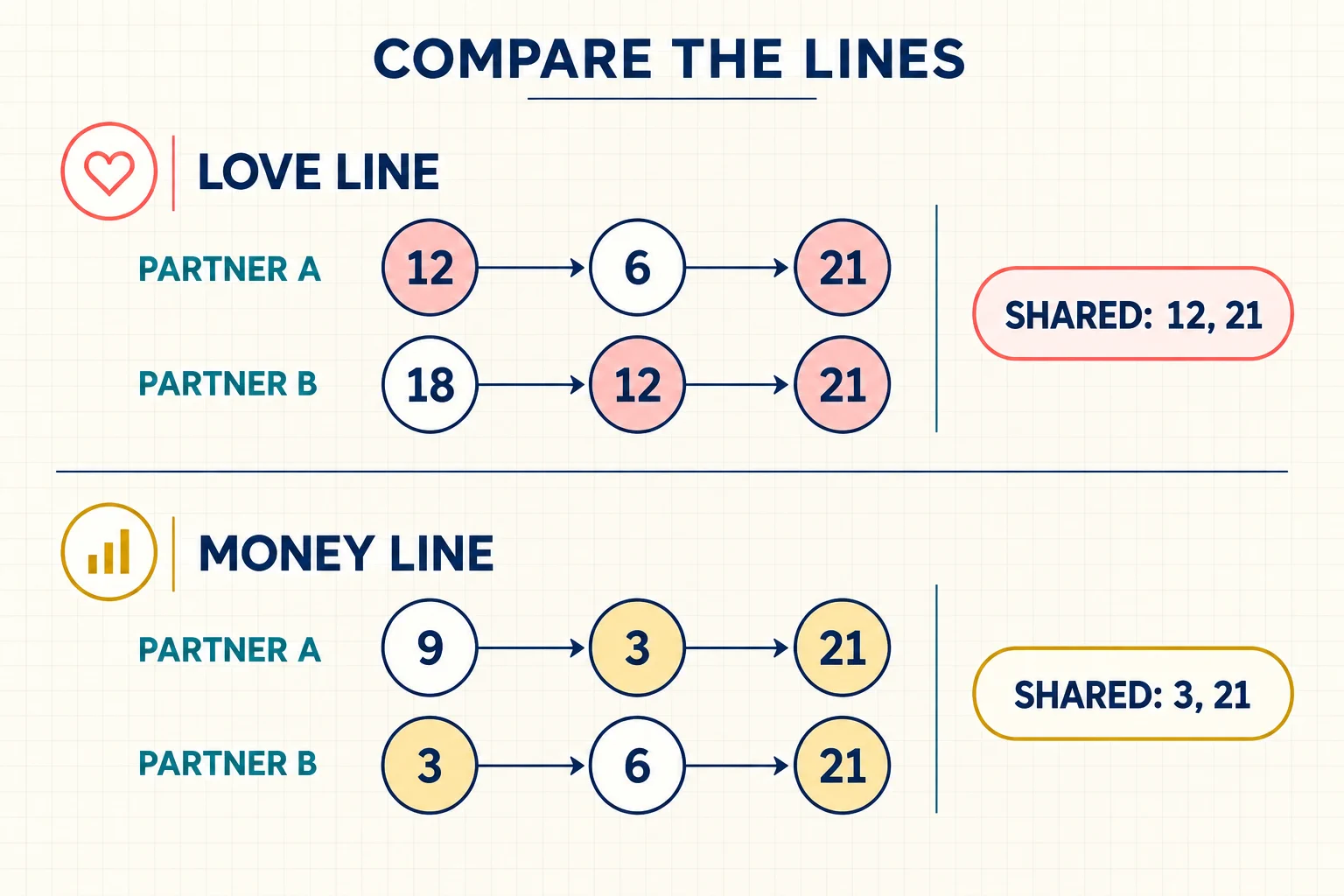
Shared values show where the two lines overlap. They do not prove that either person will express the symbol in the same way.
If the love lines share numbers, some emotional needs may feel familiar. If they do not overlap, both people may need to explain their needs more clearly. Neither result is automatically better.
Compare four things:
- How each person asks for care.
- What each person does when hurt.
- How much space or reassurance each person needs.
- How the two people reconnect after conflict.
Research offers a useful reality check here. A meta-analysis of 64 studies and 1,784 estimates found that positive and negative communication behaviors had small but reliable links with later relationship quality. Negative communication also had a small-to-moderate link with later relationship dissolution. The effects were not large enough to turn one interaction into a forecast. Look for repeated behavior over time.
7. Compare the money lines and practical needs
Practical compatibility includes money, time, work, household effort, planning, and shared resources. Strong attraction does not settle these questions.
Use each person's money line and the financial synergy point to discuss:
- spending, saving, and debt;
- who plans and who follows through;
- how shared costs are divided;
- how each person handles risk;
- which tasks are visible and which go unnoticed.
This part deserves real attention. A longitudinal study of 4,574 married couples found that disagreements about money were more strongly associated with divorce than many other common disagreements. The chart does not identify the cause. It can give both people a neutral place to begin a money conversation.
8. Read the sensitive pattern, growth edge, and score
The sensitive pattern points to situations that may trigger a strong reaction. The growth edge turns that theme into a practical question. Neither is a warning label or a measured psychological trait.
Write the growth edge in this form:
When [specific situation] happens, we tend to [observable reaction]. A better repair would be [small action both people can take].
Read the score only after the chart. Our calculator compares five separate domains. Their weights depend on the selected relationship type:
| Score component | Weight range |
|---|---|
| Core response | 15-20% |
| Connection style | 10-35% |
| Practical style | 10-35% |
| Shared purpose | 15-20% |
| Coordination bridge | 20% |
This is a site-specific formula. It is not part of the original Destiny Matrix method and has not been validated as a measure of relationship success. A high score means the selected chart patterns are more similar. A lower score means they show more contrast. Similarity can feel easy or repetitive. Contrast can feel difficult or complementary.
See your score breakdown and shared Arcana in the free compatibility preview.
Complete example: March 18, 1990 and November 4, 1992
This example uses the same sample dates as our compatibility calculator. The names are omitted because names do not affect the calculation.
These results use compatibility algorithm
dm-compatibility-2.1. The score describes symbolic pattern alignment. It is not a 60% chance that the relationship will succeed.
1. Read the two individual charts
| Chart area | Partner A: March 18, 1990 | Partner B: November 4, 1992 |
|---|---|---|
| Center | 8, Justice | 9, The Hermit |
| Love line | 12–6–21 | 18–12–21 |
| Money line | 9–3–21 | 3–6–21 |
| Personal purpose | 17, The Star | 9, The Hermit |
Partner A's Justice center emphasizes fairness, clarity, and accountability. Partner B's Hermit center emphasizes reflection, independence, and time to process. The practical question is whether requests for an immediate answer leave enough room for thoughtful reflection.
2. Read the combined chart
| Combined position | Result | Reading question |
|---|---|---|
| Center | 17, The Star | What shared hope or direction keeps both people engaged? |
| Connection point | 3, Empress | What kind of care helps the pair reconnect? |
| Relationship purpose | 17, The Star | Which shared direction needs practical support? |
| Connection center | 9, Hermit | When does reflection help, and when does it become distance? |
| Practical center | 9, Hermit | Which decisions need more time and independent thought? |
| Sensitive pattern | 13, Death | How does the pair respond when a role or plan changes? |
The combined center is 17, The Star. In a balanced form, the pair may encourage each other's plans and restore hope after a setback. Under pressure, they may focus on an ideal future while avoiding a difficult present conversation.
The connection point is 3, The Empress. Care, encouragement, and visible follow-through may help the pair feel connected. This is a symbolic theme, not proof that either person will always provide those things.
The relationship purpose is 17, The Star. Its practical expression is a shared direction that both people can support with specific next steps.
3. Compare shared Arcana and overlapping lines
The weighted shared-resonance score is 40/100. Arcana 3 and 21 carry the strongest repeated weight in this pair. Repetition may create familiarity, but it does not mean both people express each symbol in the same way.
Both connection lines end at 21, The World. The shared coordination point can support completion, but the earlier parts of the lines differ and still need direct explanation.
Both practical lines also end at 21, The World. This can provide a common reference point for finishing decisions. It does not show whether either person is financially responsible. Spending, debt, effort, and follow-through still need to be discussed directly.
4. Check the sensitive pattern
The sensitive pattern is 13, Death. Read it as transition, release, and renewal, not literal death or an inevitable breakup.
A useful repair prompt is:
When a plan, role, or expectation changes, we will name what is ending, what is staying, and what each person needs next.
5. Calculate and interpret the score
| Score component | Raw score | Weight | Weighted value |
|---|---|---|---|
| Core response | 51 | 20% | 10.2 |
| Connection style | 49 | 35% | 17.2 |
| Practical style | 58 | 10% | 5.8 |
| Shared purpose | 44 | 15% | 6.6 |
| Coordination bridge | 100 | 20% | 20.0 |
| Final score | 59.8 → 60 |
The result is 60/100, Mixed alignment. It means the selected chart features include both alignment and contrast. It does not measure love, safety, commitment, or future relationship success.
End the reading with something both people can observe and try. Do not use it to decide whether they belong together.
Free preview vs. full report
The free preview shows the combined chart, score breakdown, shared Arcana, and key relationship patterns. It is enough to follow every step in this guide.
The full report connects those positions in a longer interpretation. It adds communication patterns, conflict triggers, practical themes, and repair prompts. You can open a complete compatibility report sample to see the depth and structure before you unlock your own. First generate the free preview. If the framework feels useful, unlock the full report from that pair's result page. You can also review the full compatibility report options and pricing.
Why a reading can feel accurate
A chart may feel precise even when some of its language is broad. That sense of accuracy is worth examining carefully.
In a classic 1949 study, psychologist Bertram Forer gave participants the same general personality description while presenting it as personal. Participants still regarded it as highly accurate. This response is now known as the Forer or Barnum effect.
Use three tests for every interpretation:
- Ask for an example. When did this happen, and what did each person do?
- Try the opposite. Would the opposite description also feel true in some situations?
- Look for change. Does the pattern remain when stress, work, health, or circumstances change?
Resonance can make a prompt useful. It does not make the prompt a fact.
To update this guide, we ran a targeted evidence check on September 17, 2026. We searched PubMed, Europe PMC, and Crossref for peer-reviewed studies that tested whether Destiny Matrix compatibility predicts relationship outcomes. We combined "Destiny Matrix" and "Matrix of Destiny" with "compatibility" and "relationship." We did not find a direct validation study. This was not a systematic review, so the result does not prove that no such study exists.
The closest related research we found examined sun-sign astrology, not Destiny Matrix. It should not be treated as a direct test of this system. A Swedish longitudinal study covering more than 65,000 marriages found no consistent evidence that astrologically compatible couples married more often or had a lower risk of divorce.
Turn the chart into a real conversation
The chart becomes more useful when both people can compare it with their lived experience. Relationship research points to better reality checks than a symbolic score.
Researchers combined 43 longitudinal datasets on romantic couples from 29 laboratories. The strongest relationship-specific predictors included perceived partner commitment, appreciation, sexual satisfaction, perceived partner satisfaction, and conflict. Even then, changes in relationship quality over time were difficult to predict.
Choose one chart theme and ask:
- Do both of us recognize this pattern?
- What does it look like in a recent, specific situation?
- What does each person need when it appears?
- What is one agreement we can test this week?
- When will we check whether that agreement helped?
The following TED talk by Julie and John Gottman is a useful companion to this step. It focuses on how couples begin difficult conversations, respond under stress, pause when overwhelmed, and return to the issue.
After watching, choose one area of tension from the compatibility chart. Describe the situation without using an Arcana as a label. Replace "You are acting like the shadow of 4" with "When the plan changes without warning, I feel shut out. Can we agree to check in first?"
What the chart cannot tell you
A Destiny Matrix compatibility chart cannot tell you:
- whether a relationship will last;
- whether someone is honest or safe;
- whether you should stay or leave;
- who was right in a conflict;
- whether abuse will stop;
- whether marriage, pregnancy, or breakup will happen.
Do not use a chart to explain away fear, coercion, threats, isolation, sexual pressure, financial control, or monitoring. The U.S. Office on Women's Health lists these behaviors among the signs of relationship abuse. Real safety signals take priority over any symbolic interpretation.
The same chart also needs a different lens for each relationship type:
| Relationship | Give more weight to |
|---|---|
| Romantic | emotional safety, affection, boundaries, intimacy, and repair |
| Friendship | trust, mutual effort, availability, and respect for space |
| Family | long-standing roles, expectations, boundaries, and repeated reactions |
| Work or creative partnership | decisions, ownership, deadlines, money, and feedback |
Common mistakes
- Starting with the score. Read the relationship pattern first.
- Reading one chart as the problem. Compatibility describes an interaction.
- Treating shared Arcana as automatic harmony. The same blind spot can repeat on both sides.
- Using symbolic language instead of examples. Name what happened in plain words.
- Treating differences as failure. Differences may need discussion, not a breakup.
- Using the chart to override consent or safety. No number can make harmful behavior acceptable.
Frequently asked questions
How do I read a Destiny Matrix compatibility chart?
Read both individual charts first. Then read the combined center, meeting point, relationship purpose, shared Arcana, love line, money line, and sensitive pattern. Use the score as a final summary, not the main answer.
What does the Destiny Matrix compatibility score mean?
On this website, the score compares core response, connection style, practical style, shared purpose, and coordination bridge. Relationship-type weights change the final score. It is a site-specific reflection aid, not a scientific probability.
Does a low compatibility score mean we should break up?
No. A lower score means the selected chart features show more contrast. It does not measure love, respect, safety, commitment, or the work both people are willing to do.
Can a compatibility chart predict marriage or breakup?
No reliable evidence shows that a Destiny Matrix compatibility chart can predict either outcome. Use it to discuss patterns, not to forecast the future.
Do both people need the same or repeated Arcana?
No. Repeated Arcana may create familiarity, but difference can also be useful. The practical question is how both people handle the pattern in real life.
Do I need birth times?
No. This calculator uses two birth dates. Birth times are not required.
Can I use the chart for friendship, family, or work?
Yes. Choose the correct relationship type and interpret the chart through that context. Do not apply romantic assumptions to every connection.
Continue from your result
Already generated a chart? Return to the step-by-step reading order and keep the result open beside this guide. If you need to review one person's center or lines first, use the personal chart reading guide.
Continue Reading
What Is a Destiny Matrix Chart?
Review the system's meaning, origins, Arcana mapping, calculation rules, and practical limits.
Read guideHow to Read a Destiny Matrix Chart: Step-by-Step Guide
Learn to read each personal chart before comparing shared Arcana, relationship lines, and combined positions.
Read guide